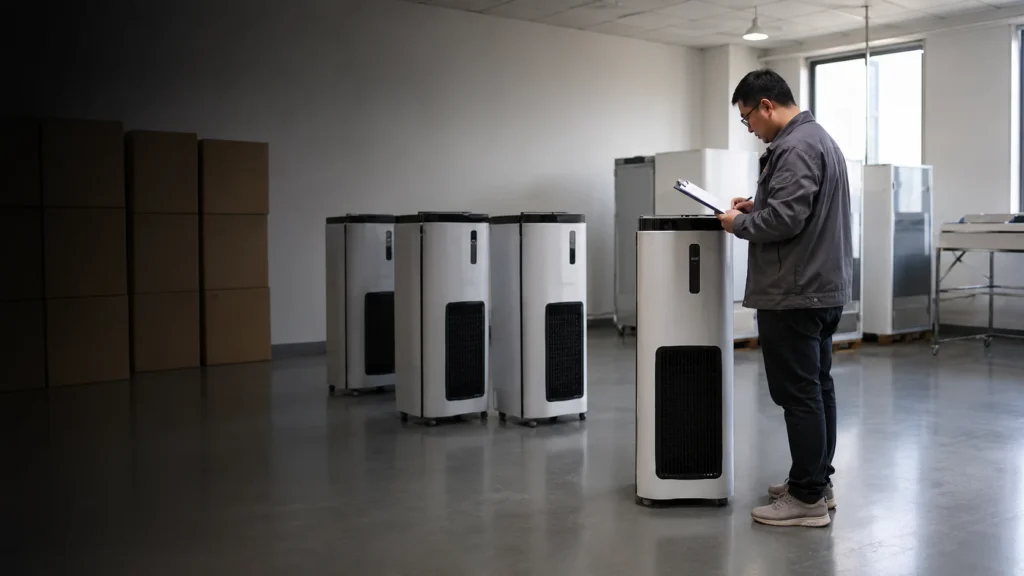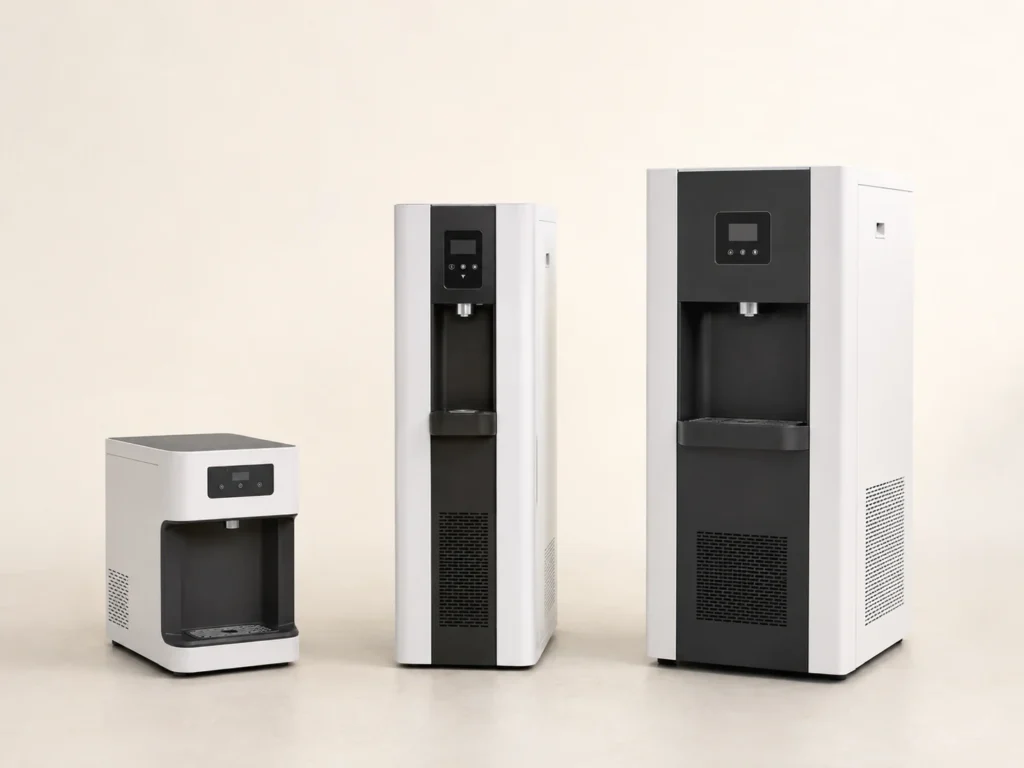
An atmospheric water generator (AWG) and a refrigerant dehumidifier can collect water through the same cooling process. Their intended outputs differ: a dehumidifier controls humidity, while a drinking-water AWG aims to supply water for consumption.
That difference demands more than an extra filter. Buyers need evidence that the entire AWG water path, treatment system, storage design, controls, and maintenance plan support drinking-water use. The name “AWG” alone proves none of those things.
For wholesalers and private-label brands, the useful comparison starts with three questions:
What touches the water?
What protects its quality?
What does the customer actually receive under real operating conditions?
This guide compares condensation-based drinking-water AWGs with conventional refrigerant dehumidifiers. Sorption systems use different moisture-capture methods and require a separate comparison.
AWG vs. Dehumidifier: The Key Differences
| Buying criterion | Conventional dehumidifier | Drinking-water AWG |
|---|---|---|
| Main task | Reduce moisture in a space | Supply drinking water under specified conditions |
| Cooling system | Condense moisture on a cold evaporator | Often use the same refrigeration principle |
| Water-contact path | Collect and discharge condensate | Document suitable materials from collection surface to outlet |
| Water treatment | Usually provide no drinking-water treatment | Match treatment stages to specific contamination risks |
| Storage | Hold condensate until emptying or drainage | Manage hygiene, drainage, residence time, and outlet protection |
| Main control target | Respond to humidity settings | Respond to water demand, tank levels, and protective controls |
| Capacity claim | Report moisture removal per day | Define net usable water output and test conditions |
| Energy comparison | Use a defined moisture-removal efficiency metric | Measure whole-unit energy per liter of usable water |
| Service needs | Maintain airflow, coils, bucket, and drainage | Also maintain the drinking-water path and treatment components |
| Purchase evidence | Check humidity-control performance | Also check outlet water quality, material evidence, and service support |
Why Do Both Machines Collect Water?
A fan moves humid air across an evaporator. Refrigerant inside the evaporator absorbs heat. When the surface temperature falls below the incoming air’s dew point, water vapor condenses on the outside surface and drains away.
The compressor, condenser, and expansion device keep the refrigeration cycle running. During normal operation, refrigerant stays inside its circuit; condensate follows a separate path.
This shared physics explains why the machines can look similar. It doesn’t establish equal water quality, equal efficiency, or equal suitability for drinking-water service.
A conventional dehumidifier sends condensate to a bucket or drain. A drinking-water AWG needs suitable collection surfaces, appropriate treatment, hygienic storage, and an outlet that preserves water quality. Those requirements begin at the collection surface, before water reaches the first cartridge.
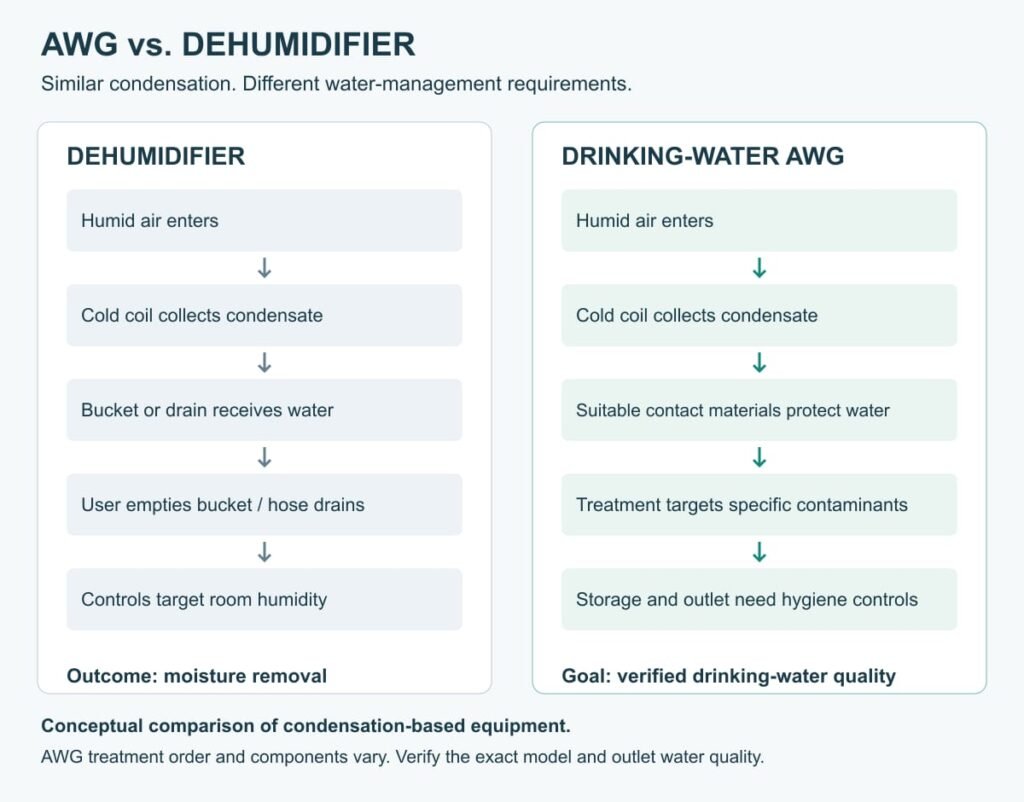
Notice:Both machines can use condensation. A drinking-water AWG must also control the water path through collection, treatment, storage, and dispensing. The diagram shows a conceptual comparison; individual designs vary.
Can You Drink Water From a Dehumidifier?
Don’t use water from an ordinary dehumidifier as drinking water.
Its moisture-removal function doesn’t demonstrate drinking-water suitability.
Water can encounter airborne particles, surface residues, microorganisms, and substances from contact materials. The bucket and drain hose add further contact points. Clear appearance doesn’t reveal these risks.
Condensation also differs from a complete distillation process. The machine cools ambient air; it doesn’t first boil a controlled feedwater supply. Some airborne chemicals can enter condensate, and surfaces can introduce contamination after droplets form.
Boiling can kill many microorganisms, but it doesn’t remove harmful metals or many chemical contaminants. A basic carbon cartridge doesn’t solve every chemical or microbial risk either.
An AWG needs scrutiny for the same reason. A dispenser, a UV lamp, or a “pure water” label cannot replace evidence for the complete system.
8 Things Buyers Should Compare Before Choosing an AWG
Water collection alone cannot tell you whether a machine suits your customers. Before placing a wholesale or private-label order, compare these 8 areas: water-contact materials, treatment, storage, output, energy use, supporting evidence, maintenance, and installation requirements.
1.Inspect Every Surface That Touches the Water
Start the inspection at the evaporator’s condensate-contact surface. Continue through the collection pan, fittings, tubing, pump, filters, tank, valves, and dispensing nozzle.
Ask the supplier for a water-path drawing and a component list. Match each contact component to its material specification and supporting documentation.
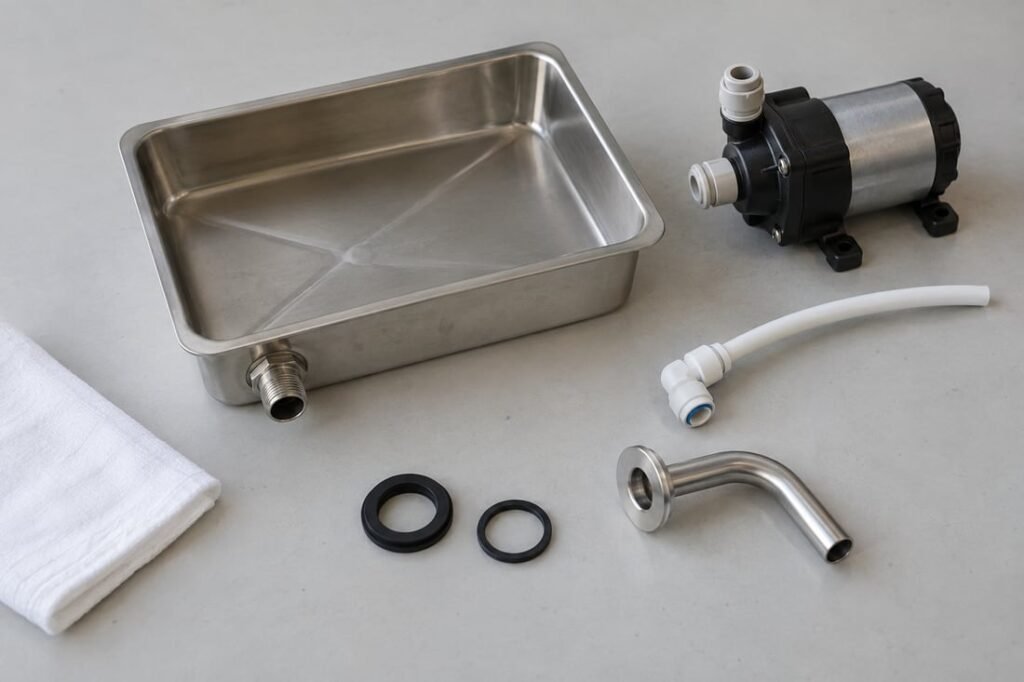
Inspect every water-contact component, from the collection pan to the outlet. These generic components illustrate inspection points; appearance alone doesn’t establish drinking-water suitability.
| Contact point | What buyers should inspect | Evidence to request |
|---|---|---|
| Evaporator surface | Base material, coating, joints, and cleaning compatibility | Exact surface specification and relevant contact testing |
| Collection pan | Drainage slope, seams, corners, and access | Drawing, material details, and drainage demonstration |
| Tubing and seals | Material identity, temperature limits, and disinfectant compatibility | Part numbers and material documentation |
| Pump and valves | Internal wetted parts and retained water | Wetted-material list and service instructions |
| Tank | Lid, vent, drain, access, and internal geometry | Tank drawing and cleaning procedure |
| Dispensing outlet | Splash exposure, contact points, and cleaning access | Outlet layout and maintenance instructions |
A stainless-steel tank doesn’t establish the suitability of the whole machine. Plastic connectors, elastomer seals, surface coatings, and adhesives also matter.
Likewise, “food grade” offers little purchasing value without a named material, test scope, and applicable use conditions. Ask whether the evidence covers the actual component and its expected contact time, temperature, and cleaning chemicals.
Treat a coating as an engineering specification. Ask how the supplier checks coverage, durability, and compatibility with cleaning. A marketing phrase such as “antibacterial coating” cannot answer those questions.
2. Evaluate Treatment Functions, Not the Number of Filters
An 8-stage system doesn’t automatically outperform a 4-stage system. Stage count says little about contaminant reduction, flow limits, bypass leakage, or maintenance quality.
Ask what each stage does and what evidence supports that function.
| Treatment stage | Potential function | Important limitation |
|---|---|---|
| Air filter | Reduce particles entering the machine | Particle filtration doesn’t reliably remove gases |
| Sediment filter | Capture particles in water | It doesn’t establish chemical or microbial safety |
| Activated carbon | Reduce certain organic chemicals, tastes, or odors | Performance depends on the media, contaminant, flow, and service life |
| Membrane stage | Reduce specific contaminants according to membrane and system design | Integrity, pressure, and bypass control matter |
| UV stage | Inactivate susceptible microorganisms with adequate exposure | UV doesn’t remove dissolved chemicals or protect all downstream surfaces |
| Mineral cartridge | Adjust mineral content and taste | Mineral addition doesn’t disinfect water |
Don’t assume every AWG needs HEPA filtration, reverse osmosis, or the same UV arrangement. Require a coherent treatment strategy for the model’s intended environment and claims.
For example, a supplier who claims metal reduction should identify the exact treatment component and the relevant reduction test. “Carbon removes impurities” lacks enough detail.
For a UV system, request its validated operating conditions, maximum flow, maintenance requirements, and response to faults. Lamp power alone doesn’t establish the UV dose that water receives. Flow, water clarity, lamp condition, and chamber geometry also affect exposure.
Ask the supplier to demonstrate what happens when treatment cannot perform as intended. A visible alarm and a dispensing lockout serve different purposes. Buyers should understand which response the machine provides.
3. Check Storage and the Final Dispensing Point
Water quality can change after treatment. A clean filter outlet doesn’t prove a clean dispensing nozzle several hours later.
A closed tank still needs appropriate venting, cleanable surfaces, and a practical drain. Circulation can help a system route water through treatment, but moving water alone doesn’t disinfect it. UV provides no lasting disinfectant residual in the tank or nozzle.
Ask these questions during the sample review:
- How does the operator empty the tank fully?
- Which corners, hoses, or branches retain water?
- How can a technician reach the tank and outlet for cleaning?
- Does circulation pass through treatment, or only move water around the tank?
- What instructions cover weekends, holidays, and long shutdowns?
- What happens after power returns?
Compare tank volume with daily demand. A large tank can support peak use, but low demand can leave water inside for longer. More storage doesn’t automatically improve the installation.
Build a sampling plan around the water that customers actually drink. Include the final outlet, normal operation, and a defined idle-and-restart condition. Choose the idle period to match the intended use, and agree on the test method before evaluation.
4. Compare Output Under the Same Conditions
A daily capacity number has little value without temperature, humidity, operating mode, and a clear measurement boundary.
For example, a supplier might quote an AWG’s output at 30°C and 80% umidità relativa. A dehumidifier might carry a capacity rating under a different test method. Those numbers don’t support a direct comparison.
Relative humidity also needs temperature context. The same RH at two temperatures can correspond to very different moisture availability. A winter office and a tropical warehouse can produce very different results with the same AWG.
Request a performance map across the conditions your customers will encounter. Ask for temperature and RH at the machine’s inlet, rather than relying only on regional weather averages.
Separate 3 quantities:
- Gross condensate: water the cooling system collects before treatment losses.
- Net product water: water available for use after flushing, reject streams, and other process losses.
- Dispensed water: water users actually draw from the outlet during the measurement period.
Tank inventory can distort a short test. For a machine with no external water feed:
Net water added to usable storage = water dispensed + ending usable storage − starting usable storage.
For this balance, record any additional water withdrawals separately. If a technician removes samples or drains the tank, document those volumes. Never count pre-existing tank water as new production.
A hybrid model with an external water connection needs separate accounting for that feed. Otherwise, a dispensing demonstration can overstate atmospheric water production.
5. Compare Electricity Per Useful Liter
Watts describe power at a moment. Kilowatt-hours describe energy over time. Neither a compressor label nor peak power alone tells buyers the operating cost per liter.
Use a consistent boundary:
Specific energy use (kWh/L) = whole-unit electricity consumption ÷ net usable water output.
Include fans, pumps, treatment, defrost, controls, and normal standby operation. If a model provides hot or chilled water, show those loads separately or include them consistently in both offers.
ENERGY STAR expresses dehumidifier Integrated Energy Factor (IEF) in liters per kilowatt-hour under a defined test method. An AWG’s field kWh/L figure may cover different conditions and loads. Taking the reciprocal of IEF doesn’t create a directly comparable AWG operating result.
The category name cannot identify the more efficient machine. Compressor selection, heat exchange, airflow, climate, controls, and treatment loads all influence performance.
A transparent cost example
The following numbers illustrate the calculation only; they don’t describe a YESolid model or a market benchmark.
| Input | Hypothetical value |
|---|---|
| Whole-unit electricity over 24 hours | 12 kWh |
| Net usable water over the same period | 24 l |
| Electricity price | $0.15/kWh |
| Specific energy use | 0.50 kWh/L |
| Electricity cost per liter | $0.075/l |
The calculation excludes equipment, filters, cleaning labor, testing, repairs, and backup water.
For a commercial comparison, use:
Total cost per liter = all ownership and operating costs over a defined period ÷ usable liters delivered over that period.
Choose the same ownership period and demand assumptions for every offer. Include downtime and seasonal output changes. A low purchase price can lose its advantage when proprietary cartridges, frequent service, or low winter output increase costs.
For drinking-water procurement, compare the AWG with other suitable drinking-water supplies. Raw condensate from a conventional dehumidifier doesn’t provide an equivalent product.
6. Verify What Reports and Certifications Actually Cover
Separate 3 kinds of evidence:
| Evidence | What it can demonstrate | What it doesn’t establish by itself |
|---|---|---|
| Material or component documentation | Suitability or performance within its stated scope | Complete-machine drinking-water performance |
| Laboratory water report | Results for particular samples and test conditions | Every installation, operating state, or future production batch |
| Product certification listing | Compliance with the listed requirements and claims | Every contaminant claim or every model in a product family |
Relevant treatment standards address different functions. NSF/ANSI 42 covers aesthetic effects; NSF/ANSI 53 covers specific health-related reduction claims; NSF/ANSI 55 addresses UV systems; NSF/ANSI 58 addresses reverse osmosis systems. A standard number never means “removes everything.”
Check the exact model, component, configuration, claimed reductions, and listing status. A cartridge certification doesn’t automatically cover the complete AWG. A private-label name also needs a clear documentary link to the evaluated product.
For water testing, request the laboratory identity, relevant accreditation scope, sample location, sampling date, methods, detection limits, and operating conditions. Agree with a qualified laboratory on a panel that matches the destination market and installation risks.
A TDS reading can indicate changes in dissolved ionic content. It cannot detect pathogens or verify the absence of many organic contaminants. Good taste and low TDS cannot replace a suitable water-quality assessment.
7. Review Maintenance Before You Place a Bulk Order
Wholesalers sell an ongoing service obligation along with the machine. Private-label brands inherit the customer’s experience when a filter leaks, a nozzle needs cleaning, or a replacement part takes weeks to arrive.
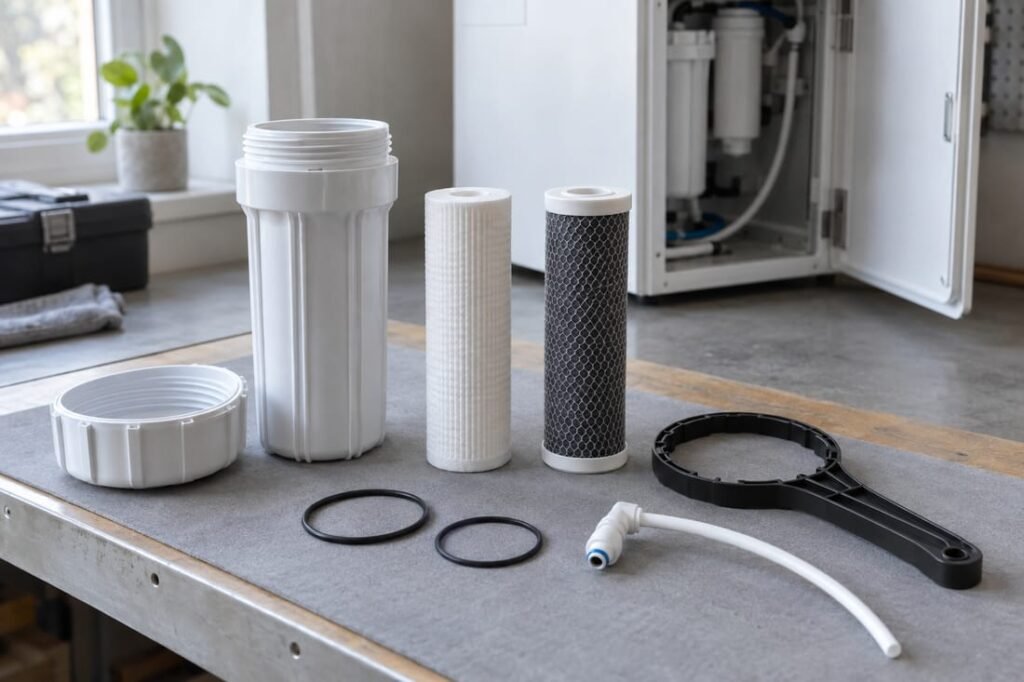
Illustrative service components. Match every replacement to the exact model, material requirements, and treatment specification; appearance alone doesn’t establish compatibility.
Request a spare-parts schedule that includes air filters, water cartridges, seals, pumps, sensors, valves, and the UV source when the model uses one.
For each consumable, document the part number, compatible models, replacement trigger, storage requirements, lead time, and price. Ask whether the service interval follows elapsed time, operating hours, water volume, site conditions, or a combination.
Physical fit alone doesn’t establish filter compatibility. Two cartridges with the same dimensions can differ in media, pressure drop, contaminant capacity, seals, and flow limits. An unsuitable replacement can change performance even when the housing closes correctly.
Ask a technician to demonstrate a normal service visit. Time access, replacement, flushing, pulizia, leak checks, and restart. Use that demonstration to estimate realistic labor costs.
For private-label orders, agree on change control. Require the supplier to notify you before changing water-contact materials, cartridges, treatment components, or control logic. Determine which changes require updated documentation or repeat testing before shipment.
8. Match the Machine to the Installation
Choose a dehumidifier when the main task involves controlling dampness. Choose an AWG for drinking-water supply only after the climate, power supply, water-quality evidence, and service plan support that use.
An AWG removes moisture while it produces water, but that side effect doesn’t guarantee reliable room humidity control. A full tank may stop production even when the room remains humid.
Both machines can also draw from the same moisture supply. An air conditioner or dehumidifier that dries the AWG’s intake air can reduce its output. Don’t assume two appliances in one room operate independently.
Check airflow clearance and prevent dry exhaust air from feeding directly back into the inlet. Many self-contained refrigerant units discharge warmer, drier air into the room. Account for ventilation and cooling demand rather than treating the AWG as an air conditioner.
Avoid locating the intake near exhaust fumes, solvent use, or other identified pollution sources. An air filter doesn’t make every location suitable.
For backup supply, compare daily demand with conservative seasonal output. Include power outages, maintenance, and reserve storage in the plan. An AWG that requires electricity cannot provide uninterrupted production during an outage without a suitable power system.
A Practical Acceptance Plan for Wholesale and Private-Label Orders
Use the following framework to turn supplier promises into a repeatable evaluation. Agree on the details before testing; this framework doesn’t replace a formal certification protocol.
| Evaluation step | What to record | Purchase decision |
|---|---|---|
| Confirm configuration | Model, voltaggio, water path, cartridges, firmware, and optional functions | Ensure the sample represents the order |
| Verify documentation | Contact materials, treatment claims, reports, and exact listings | Resolve gaps before approving drinking-water claims |
| Measure production | Inlet conditions, test duration, tank levels, losses, and net output | Compare against an agreed performance envelope |
| Measure energy | Whole-unit kWh and operating modes over the same test period | Calculate a comparable cost per usable liter |
| Assess outlet water | Laboratory results during normal use and defined idle/restart conditions | Check the agreed quality criteria |
| Demonstrate controls | Full-tank response, treatment faults, alarms, and power recovery | Confirm what protection the customer receives |
| Demonstrate maintenance | Service time, cleaning access, flushing, and replacement parts | Confirm the local service model |
| Establish production checks | Traceability, inspection records, and change notification | Maintain consistency beyond the first sample |
Ask for results at a representative condition and a less favorable condition within the intended operating range. A single favorable demonstration cannot establish year-round performance.
Frequently Asked Questions
Q1.Is an atmospheric water generator just a dehumidifier with a filter?
It can share the cooling mechanism, but a credible drinking-water design needs suitable contact materials, validated treatment performance, hygienic storage, protective controls, and a workable maintenance plan. One added filter doesn’t establish those functions.
Q2.Can an AWG replace a dehumidifier?
Only if its humidity-control capability matches the room’s needs.
Water-demand controls and full-tank shutdown can interrupt moisture removal. Check humidity-control performance separately from drinking-water production.
Q3.Does every AWG need reverse osmosis?
NO. Treatment should match the source risks and required output quality.
If a model uses RO, check contaminant-reduction evidence, net water recovery, reject-water handling, and energy use. If it omits RO, verify how its alternative treatment meets the relevant requirements.
Q4.Does more filtration mean safer water?
NO. Effective treatment depends on the right functions, correct flow, sound installation, and maintenance.
More cartridges can add pressure loss and service work without addressing the actual contamination risk.
Q5.Which machine costs less to run?
Compare exact models under the same conditions and measurement boundary.
Also compare equivalent outcomes: humidity control for a dehumidifier, or usable drinking water for an AWG. No universal category-level efficiency claim answers that question.
Q6.What should a private-label buyer request first?
Request the exact-model water-path drawing, water-contact material evidence, outlet water reports, performance map, whole-unit energy data, and spare-parts schedule.
Those documents reveal more than a cabinet photograph or a maximum liters-per-day claim.
Choose the Product Around the Customer’s Actual Need
A dehumidifier earns its place through humidity control. An AWG earns its place through useful water output, verifiable drinking-water performance, and reliable service.
For your next AWG inquiry, send YESolid your target market, daily water demand, expected inlet temperature and humidity, power supply, and hot/cold dispensing requirements. Request a model-specific proposal with performance conditions, water-treatment details, and a matching spare-parts plan.