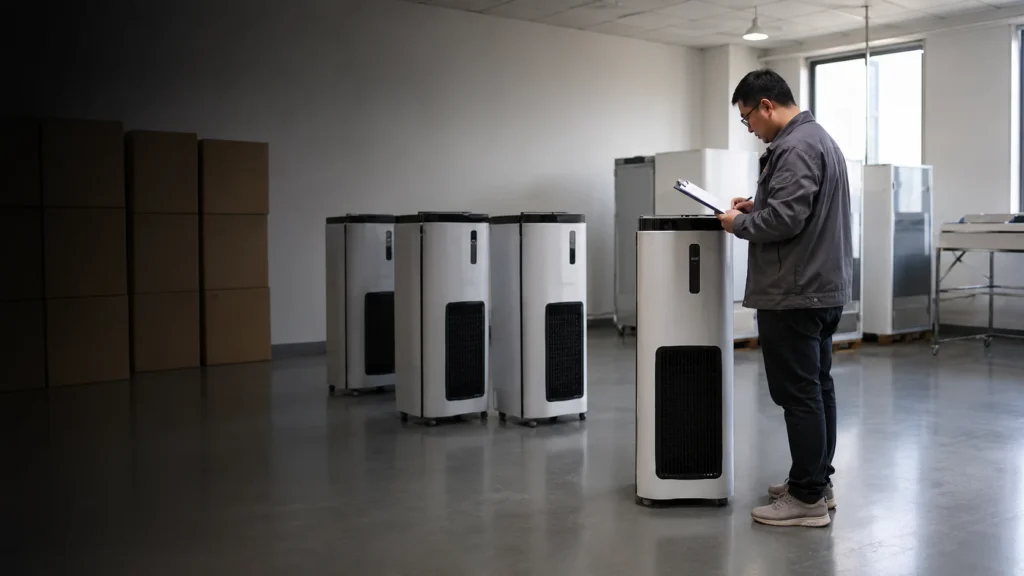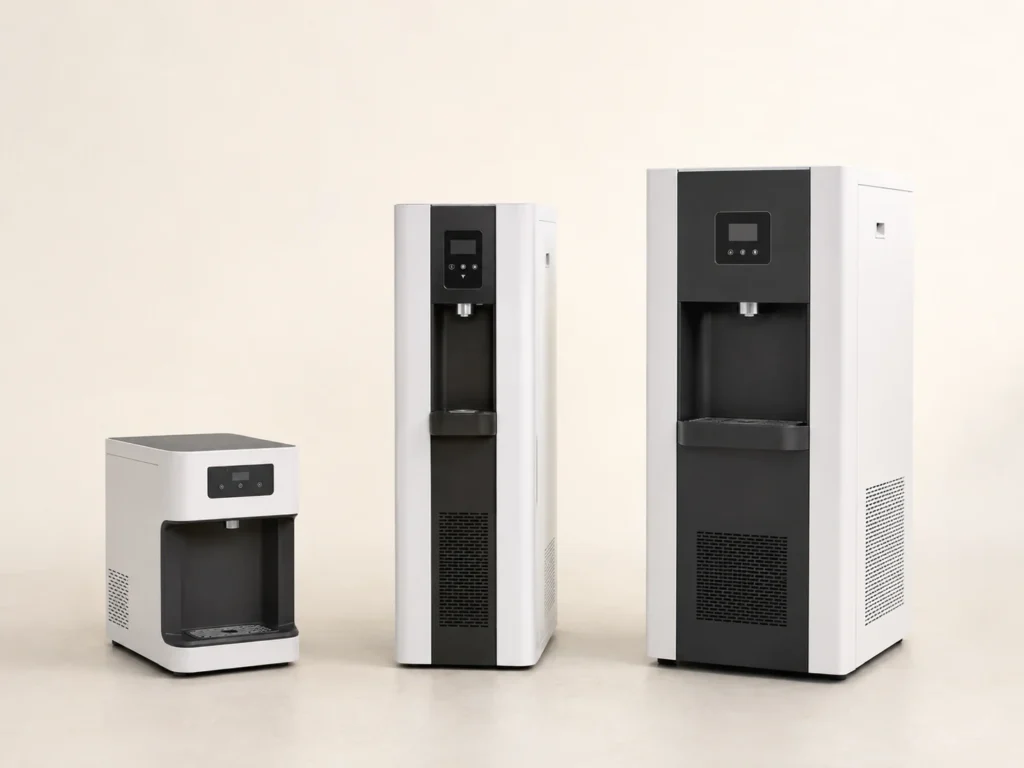
Air Water Generator (AWG), also called “Atmospheric Water Generator”, extracts water vapor from the surrounding air. A refrigeration-based AWG cools a surface below the air’s dew point, collects the resulting droplets, and moves the water through treatment and storage before dispensing it.
The machine harvests existing moisture; it doesn’t create new water molecules. Its drinking-water performance depends on the entire system: air handling, koeling, collection surfaces, waterbehandeling, storage, controls, and maintenance.
For wholesalers and private-label brands, this distinction matters. It helps you compare output claims, explain operating limits, and assess the parts and service support that customers will need.
This guide focuses on compressor-driven, condensation-based AWGs. It also explains how sorption technologies differ.
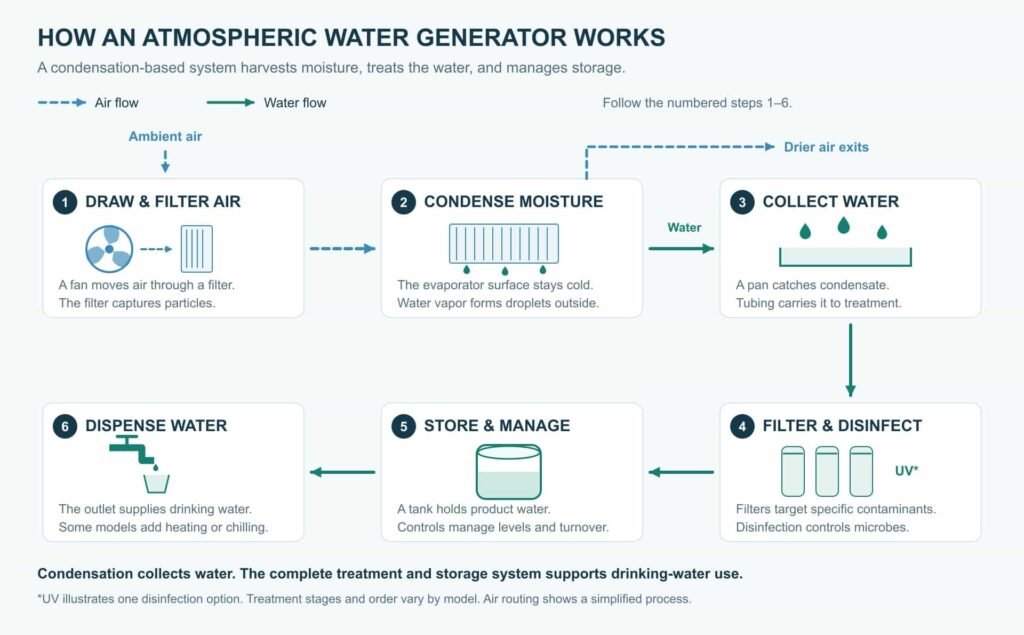
How does an air water generator work in 6 steps?
- Draw in air. A fan moves ambient air through a particle filter.
- Condense moisture. A refrigeration system keeps a heat-exchange surface below the incoming air’s dew point.
- Collect droplets. A drain pan and tubing route condensate into the water system.
- Treat the water. Filters address specific contaminants; disinfection supports microbial control.
- Store and manage water. Tanks, circulation, and controls manage water between production and use.
- Dispense water. A pump or another delivery arrangement supplies the outlet. Some models also heat or chill the water.
Output varies with operating conditions. Buyers should compare net product-water output and whole-unit energy use at the same temperature, humidity, and operating mode.
Why does water form on a cold surface?
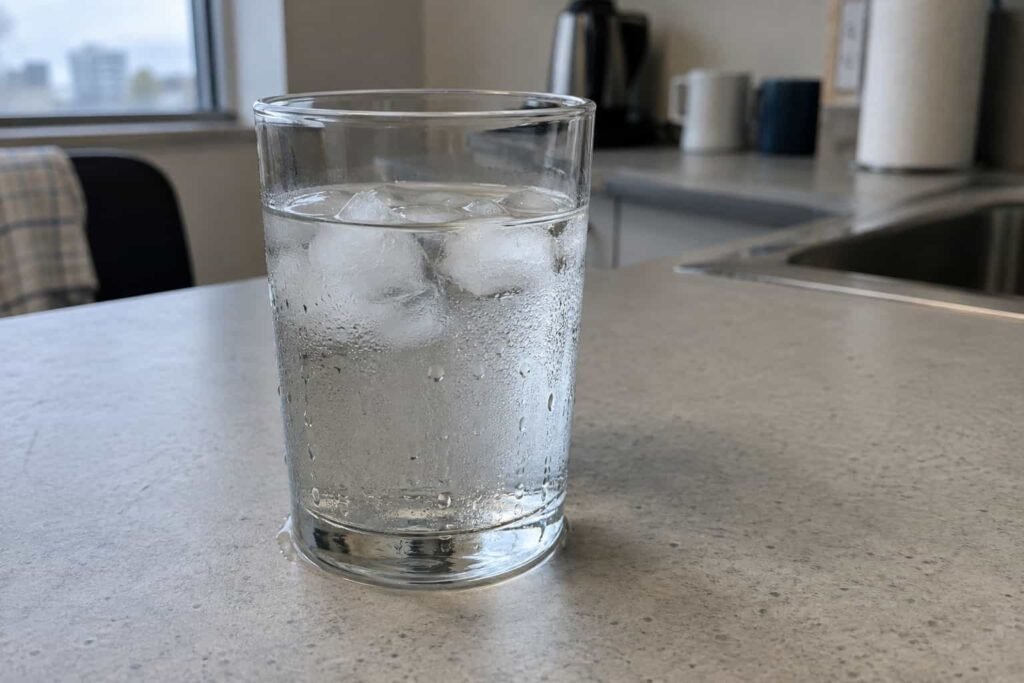
A cold glass develops droplets when its surface cools nearby humid air enough for water vapor to condense. A condensation-based AWG controls this process and adds collection, behandeling, and delivery equipment.
3 terms explain the basic physics:
| Term | Meaning | Why it matters for an AWG |
|---|---|---|
| Air temperature | The temperature at the machine’s inlet | Influences moisture conditions and cooling load |
| Relatieve vochtigheid (RV) | Actual water-vapor pressure as a percentage of saturation vapor pressure at the same temperature | Needs temperature context; RH alone doesn’t quantify available water |
| Dew point | The temperature at which air reaches saturation during cooling at essentially constant pressure and moisture content | Indicates the surface temperature that allows condensation to begin |
Dew point helps describe moisture conditions more clearly than relative humidity alone. The same RH can accompany very different amounts of water vapor at different temperatures.
For example, air at 30°C and 60% RH has a dew point of about 21.4°C. A surface below that dew point can collect condensate. The amount still depends on airflow, heat transfer, surface conditions, and the machine’s capacity.
Condensation onset doesn’t establish useful production capacity. A few droplets prove the physical process; sustained output requires a complete system that manages heat and moisture continuously.
What happens inside the machine?
Step 1: The fan draws air through the intake filter
The fan brings ambient air into the heat-exchange section. An intake filter captures particles within its performance range and helps limit dirt buildup on internal surfaces.
Filter performance depends on the medium, rating, seals, face area, and airflow. A label such as “high-efficiency filtration” doesn’t supply enough detail for a technical comparison.
Also distinguish particle filtration from gas removal. A particle filter doesn’t establish protection against every gaseous pollutant. Different pollutants require different treatment methods; no single particle filter handles them all.
More restrictive filtration can also change airflow. Designers must balance filtration, fan capability, pressure drop, and service access.
Buyer check: Ask for the filter specification, replacement method, sealing arrangement, and maintenance indicator. Check whether local dealers can obtain the correct replacement.
Step 2: The refrigeration circuit maintains a cold surface
A typical vapor-compression circuit contains four main components:
| Component | What it does |
|---|---|
| Compressor | Raises refrigerant-vapor pressure and drives refrigerant circulation |
| Condenser | Rejects heat and turns refrigerant vapor into liquid |
| Expansion device | Reduces pressure and meters refrigerant into the evaporator |
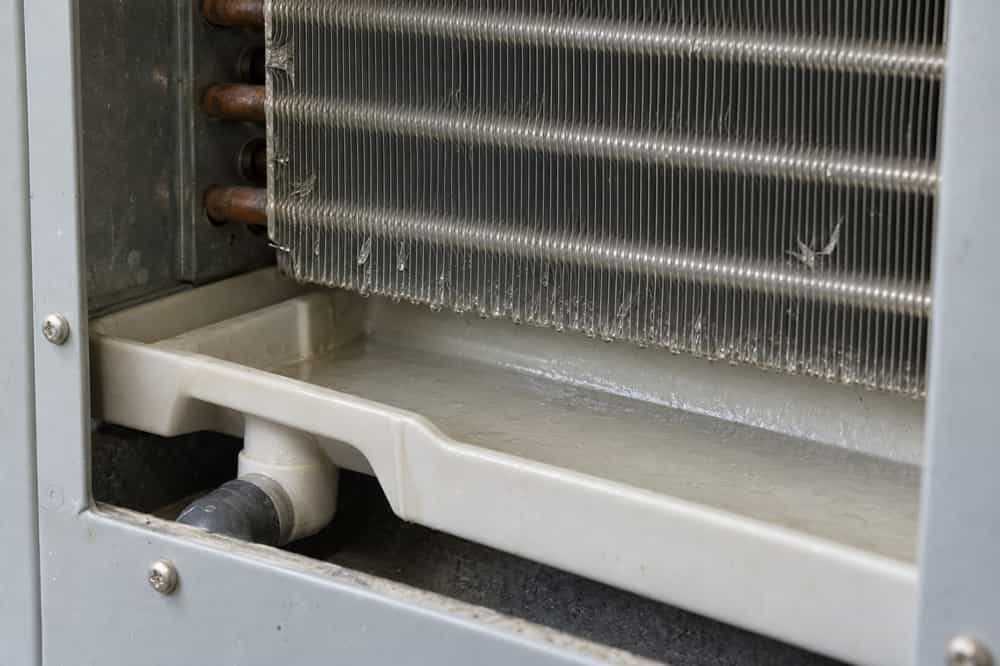
| Evaporator | Absorbs heat as refrigerant evaporates, maintaining a cold heat-exchange surface |
The components move heat through a refrigerant circuit.
Water vapor typically condenses on the outside of the evaporator. Refrigerant condenses inside the condenser. These two condensation processes involve different fluids and different locations.
Lower surface temperatures don’t guarantee better output. Excessive cooling can cause frost, restrict airflow, and trigger defrost cycles. The controller must balance condensation, energy use, frost management, and equipment protection.
Buyer check: Request the operating envelope and defrost description. Don’t infer whole-machine performance from compressor size or brand alone.
Step 3: The collection system directs droplets into the water path
Droplets run into a collection pan, then enter treatment equipment or an intermediate reservoir. Small design details influence drainage, cleanliness, and service work.
Inspect the following features:
- A pan geometry that drains without unnecessary pockets of standing water.
- Tubing routes that limit persistent stagnant sections.
- Suitable materials throughout the water-contact path.
- Access for inspection, schoonmaak, and component replacement.
- Clear separation between raw condensate and product water where the design requires it.
Condensate contacts air, surfaces, tubing, and reservoirs. Collection alone doesn’t establish drinking-water quality.
Step 4: Filters address specific water-quality risks
Manufacturers select treatment stages according to the intended use, water-quality risks, and target-market requirements. Not every AWG needs the same treatment sequence.
| Treatment component | Main function | Limit or question to check |
|---|---|---|
| Sediment cartridge | Captures particles within its rated range | Doesn’t address all dissolved contaminants or microorganisms |
| Activated carbon | Adsorbs certain compounds and helps address some taste and odor problems | Needs suitable media and contact conditions; doesn’t replace disinfection |
| Ultrafiltration (UF) | Retains particles and microorganisms within the membrane’s capability | Performance depends on membrane specification and integrity; generally doesn’t remove dissolved salts broadly |
| Reverse osmosis (RO) | Reduces many dissolved substances and provides a membrane barrier | Adds pressure, recovery, concentrate-management, and maintenance considerations |
| Mineralization cartridge | Adjusts mineral composition, taste, or water chemistry | Doesn’t replace filtration or disinfection |
Ask what each stage does, which evidence supports that function, and how flow rate and service life affect performance. A longer cartridge list doesn’t automatically establish better water quality.
Certification to a treatment standard doesn’t establish reduction of every possible contaminant. Check the specific model and reduction claims.
Step 5: Disinfection and storage work together
Some AWGs use ultraviolet treatment in a flow-through chamber, a storage arrangement, or a recirculation path. Other designs use different or additional treatment methods.
UV performance depends on dose delivery, water clarity, flow conditions, and equipment condition. A glowing lamp alone doesn’t verify an adequate UV dose.
Upstream filtration helps UV treatment by reducing particle interference. UV doesn’t remove chemical contaminants.
Storage design also needs attention. Buyers should check tank access, protective closures and vents, usable volume, water turnover, and the route through any recirculation treatment.
A circulation pump moves water. It doesn’t disinfect water by itself. Follow the actual water path and confirm which treatment stages the circulation loop includes.
Buyer check: Ask how the system detects treatment faults, what action it takes, and how the operating manual handles extended shutdowns.
Step 6: The delivery system supplies the outlet
A pump or another delivery arrangement moves product water to the tap, an external tank, or a downstream distribution system. Hot-and-cold models add heating or chilling functions, which change energy use and storage requirements.
Keep three specifications separate:
- Daily production: How much new water the machine produces over time.
- Usable storage: How much water the tank supplies between its operating levels.
- Dispensing flow: How quickly the outlet delivers water at a given moment.
A machine can fill a glass quickly from storage while making replacement water much more slowly. A larger tank handles short demand peaks; it cannot correct a persistent production shortfall.
How do the air, refrigerant, and water paths differ?
Below diagram shows the AWG refrigeration cycle and how water condenses on the evaporator and drains into a collection pan.
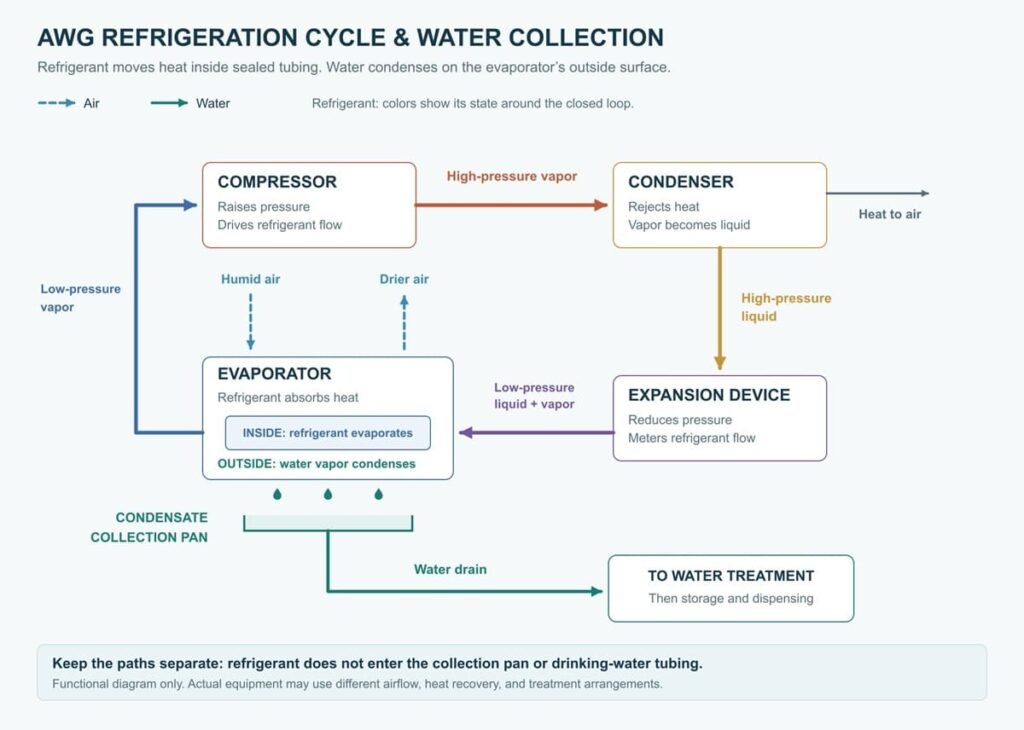
Read an AWG diagram as three separate paths. This prevents confusion about where condensation occurs and which parts contact drinking water.
| Path | Typical sequence | Main job |
|---|---|---|
| Air | Ambient air → intake filter → cold heat-exchange surface → downstream heat exchange or discharge | Supplies moisture and participates in heat transfer |
| Koelmiddel | Compressor → condenser → expansion device → evaporator → compressor | Moves heat through a closed circuit |
| Water | Collection surface → pan → treatment → storage → outlet | Collects, treats, and delivers water |
Attention: Actual models vary the heat-exchanger arrangement and may place treatment stages before and after storage.
Under normal operation, refrigerant remains inside its sealed circuit. It should not enter the drinking-water path.
A compressor specification therefore tells only part of the story. Buyers also need the water-contact materials, treatment layout, controls, and service design.
Why does output change at the same relative humidity?
The same RH doesn’t mean the same amount of water per cubic meter of air. Temperature changes the relationship.
The examples below show approximate moisture density and dew point:
| Air temperature | Relatieve vochtigheid | Water vapor in one cubic meter of air | Dew point |
|---|---|---|---|
| 30°C | 60% | 18.2 g/m³ | 21.4°C |
| 15°C | 60% | 7.7 g/m³ | 7.3°C |
| 30°C | 80% | 24.3 g/m³ | 26.2°C |
| 20°C | 80% | 13.8 g/m³ | 16.4°C |
Notice: Calculation examples, not machine test results. Values use a saturation-vapor-pressure approximation and the ideal-gas relationship, with rounding to one decimal place.
At 60% RV, air at 30°C contains about 2.4 times as much water vapor per cubic meter as air at 15°C. That doesn’t mean a machine will produce 2.4 times as much water. It still leaves some moisture in the outgoing air, and its refrigeration and airflow limits also matter.
Actual production depends on:
- Airflow through the working heat-exchange area.
- Surface temperature and effective heat-transfer area.
- Moisture that remains in the leaving air.
- Refrigeration capacity at the operating condition.
- Frost, defrost, and protection cycles.
- Filter and heat-exchanger cleanliness.
Higher ambient temperature doesn’t always help. Excess heat can increase the load on heat rejection or push the unit beyond its operating range.
Compare water output and energy use across operating conditions rather than relying on one headline rating.
How should buyers use local climate data?
Start with conditions at the proposed air inlet, including seasonal changes. Compare those conditions with the target model’s performance data. Then check expected supply against daily demand, peak demand, and backup arrangements.
Annual average temperature and RH support an initial screen, but they can hide long periods of low production. Larger projects benefit from monthly or hourly analysis.
Also distinguish outdoor weather records from conditions inside an air-conditioned building.
How much usable water does an AWG actually produce?
For the customer, usable product water matters more than raw condensation.
| Quantity | What it measures | Common comparison error |
|---|---|---|
| Gross condensate | Water that the collection system captures | Counting all condensate as usable product water |
| Net product water | New usable product water after relevant treatment and operating losses | Ignoring flushing, discharge, or other losses |
| Dispensed water | Water that leaves the outlet during a test | Including water already in the tank before the test |
For an RO-equipped unit, request the concentrate route and recovery strategy. Recirculating a stream doesn’t remove the need to account for final discharge and water-quality control.
If a machine accepts an external water supply, isolate that supply during an air-only production test or meter it separately. Otherwise, outlet volume doesn’t establish atmospheric production.
For a test with no external water input, use a product-water inventory balance:
Net product water = water dispensed during the test + ending product-water inventory − starting product-water inventory.
Measure comparable inventories and account for external tanks within the test boundary. Log flushing, drains, sampling, and unusual operating events separately.
A circulation meter mustn’t count repeated passes of the same water as new production.
This approach helps buyers distinguish actual output from a large prefilled tank or a short demonstration.
Why does an AWG use electricity, and how do you compare efficiency?
A condensation-based AWG cools incoming air and removes the heat that water vapor releases during condensation. The compressor, fans, pumps, and controls consume electricity.
UV treatment, chilling, heating, and storage-management functions may add further loads.
Don’t confuse 3 units:
| Unit | Meaning | Use in procurement |
|---|---|---|
| kW | Power at a given moment or a stated rating | Helps assess electrical demand |
| kWh | Energy consumption over time | Supports operating-cost calculations |
| kWh/L | Energy per liter of water | Supports efficiency comparisons under matching conditions |
A useful procurement metric is:
Specific energy consumption = whole-unit electricity consumption ÷ net product-water output over the same test period.
Suppose a unit consumes 24 kWh and produces 48 L of net product water:
24 kWh ÷ 48 L = 0.50 kWh/L.
At an electricity tariff of $0.15/kWh:
0.50 kWh/L × $0.15/kWh = $0.075/L in electricity cost.
These hypothetical values demonstrate the calculation. They don’t represent an industry average or a product claim. The cost excludes equipment depreciation, consumables, labor, and repairs.
For meaningful comparisons, match inlet temperature, RV, test duration, water-accounting method, and operating mode.
Ask whether the energy figure includes:
- Fans, pumps, and controls.
- UV and other treatment components.
- Defrost cycles.
- Standby and storage-management functions.
- Water heating and chilling.
Separate tests can show production-only and full-service performance. Each result needs a clear boundary.
If you add solar power, assess the unit’s actual energy profile, inverter capacity, and storage needs. Solar supply doesn’t change the machine’s underlying consumption.
Can you drink water from an air water generator?
An AWG can supply drinking water when its design, behandeling, operation, and verification support that use. Raw condensate alone doesn’t establish drinking-water safety.
Airborne compounds can enter condensate. Contact surfaces, tubing, storage conditions, and maintenance also influence quality.
Some volatile organic compounds in air can dissolve in condensate, and certain compounds can support microbial growth in plumbing and storage. The complete water path therefore needs appropriate treatment and hygiene controls.
Buyers should review 4 kinds of evidence:
- Outlet-water results. Raw condensate, tank samples, and final outlet samples answer different questions. Review evidence that relates to the intended drinking-water outlet.
- Model and configuration identity. Match the report to the machine, treatment stages, and relevant materials. Don’t transfer conclusions automatically between configurations.
- Sampling and operating conditions. Check dates, operating state, test methods, parameters, and results. Assess longer operation and restart conditions when project risks justify those tests.
- Distinct compliance scopes. Electrical safety, water-contact material suitability, and water-quality testing answer different questions. One doesn’t replace another.
A low total dissolved solids (TDS) reading cannot establish microbial safety or rule out all chemical contaminants. Treat the display as one measurement, not a complete water-quality assessment.
How does an AWG differ from a dehumidifier or water purifier?
Some devices share components, but their intended functions differ.
| Feature | Drinking-water condensation AWG | Ordinary dehumidifier | Conventional water purifier |
|---|---|---|---|
| Main task | Harvest moisture and manage water for drinking use | Reduce air humidity | Treat an existing liquid-water supply |
| Water source | Air water vapor | Air water vapor | Mains water or another suitable feed |
| Koeling | Common in condensation models | Common in compressor models | Usually unnecessary for filtration alone |
| Water-path design focus | Drinking-water contact, behandeling, storage, and delivery | Moisture removal and condensate drainage | Feed-water compatibility and treatment performance |
| Key measures | Output at stated conditions, net-water energy use, water quality | Moisture-removal capacity and energy performance | Flow, contaminant reduction, and cartridge service life |
An ordinary dehumidifier can collect water through the same basic physics. Its collection function doesn’t establish drinking-water suitability.
Adding a final cartridge doesn’t automatically address every upstream material, hygiene, or treatment issue.
A conventional purifier needs an existing water source. An AWG reduces dependence on an inlet water connection, but still needs suitable air conditions, energy, and maintenance.
Do all air water generators use refrigeration?
Nee. Atmospheric water harvesting also includes sorption technologies.
Adsorption collects moisture on a solid material’s surfaces and within its pores.
Absorption takes moisture into an absorbing medium.
Many sorption systems then use heat or another regeneration mechanism to release the captured water, often followed by vapor condensation.
Researchers have demonstrated adsorption-based devices for arid conditions. Buyers should still distinguish sorbent-material results, laboratory-device performance, and commercial system capacity.
Compare technologies using:
- Net output under local conditions.
- Electricity and heat inputs.
- Operating hours or production cycles.
- Equipment footprint.
- Material life and maintenance.
- Complete water-treatment requirements.
“Solar-powered” describes the energy source, not the water-harvesting mechanism. Photovoltaics can supply a refrigeration unit; solar heat can help regenerate certain sorption systems.
Evaluate the underlying process and the energy supply separately.
How do controls manage production and storage?
Controls coordinate production, tank levels, behandeling, and equipment protection. Features vary by model, so confirm actual sensor coverage and operating logic.
| Condition | Possible control response | Practical effect |
|---|---|---|
| Tank reaches its upper operating level | Pause or reduce production | Avoids further filling |
| Water level drops after dispensing | Restart production when conditions permit | Replenishes storage |
| Frost develops or frost conditions arise | Defrost or adjust operation | May temporarily reduce output |
| Ambient conditions exceed limits | Restrict operation or trigger protection | May pause water production |
| Treatment component reports a fault | Raise an alert and apply the model’s response | Prompts service or limits a function |
| No one dispenses water for an extended period | Run the model’s storage-management routine | Manages water between uses |
| Power returns after an outage | Run startup delays, checks, or recovery steps | Influences restart timing |
A temporary pause doesn’t necessarily indicate compressor failure. Full storage, unsuitable conditions, or defrost may explain it.
Likewise, a “normal” status screen doesn’t verify every water-quality parameter. Ask what each sensor measures and which conditions require separate testing.
How do installation and maintenance affect performance?
Check inlet and exhaust conditions
The unit needs an ongoing supply of suitable air. Restricted spaces or exhaust that returns to the inlet can change operating conditions.
Measure at the inlet rather than relying only on a weather app.
Account for indoor air conditioning
Air conditioning changes temperature and moisture levels. An indoor AWG also removes moisture and rejects heat.
Consider room ventilation and cooling demand when you assess the installation.
Maintain filters and heat-exchange surfaces
Dirt changes airflow and heat transfer. Follow model-specific instructions and adjust inspection frequency to site conditions.
Don’t apply one replacement interval to every climate and installation.
Maintain the complete water path
Cartridges, connections, seals, tanks, and treatment components all matter.
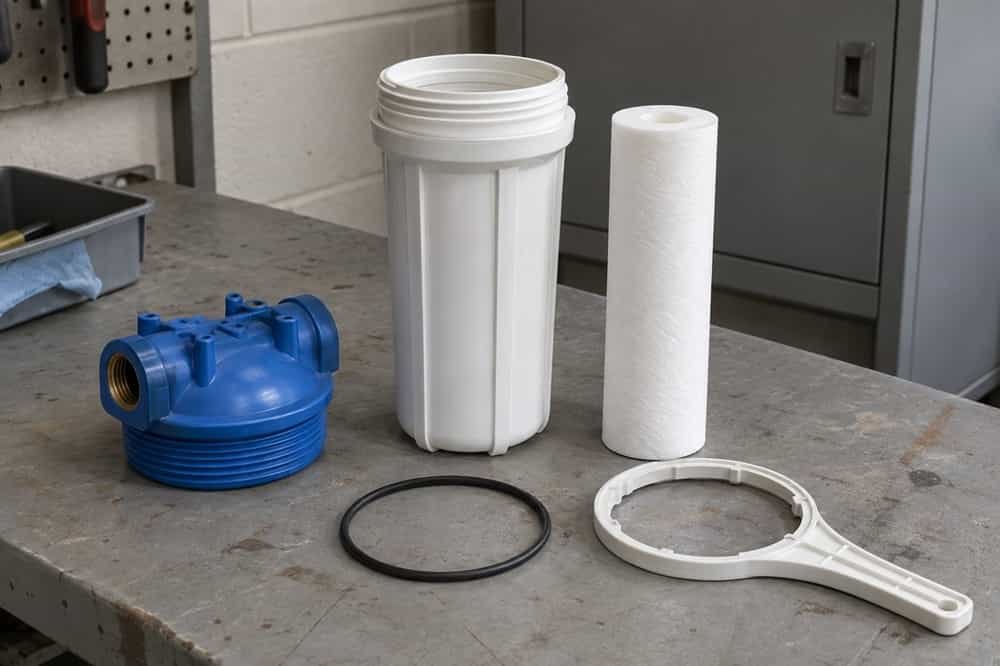
A replacement cartridge needs the correct specification, a sound seal, and the required flushing and reset procedure.
Plan for shutdown and restart
Extended shutdowns can change stored-water conditions. Follow the model’s restart procedure for tanks, tubing, consumables, and treatment units.
Don’t assume the same procedure fits every machine.
For distributors, service access affects support costs. Ask the supplier to demonstrate filter replacement, tank access, drainage, and fault-log retrieval before placing a volume order.
What should wholesalers and private-label brands request from a supplier?
Use the operating principle to turn a product claim into a verifiable procurement requirement.
| Review area | Evidence to request | What it helps you assess |
|---|---|---|
| Technology | Operating description and system diagram | How the machine harvests water |
| Luchtbehandeling | Inlet/exhaust layout and installation requirements | Fit for the proposed site |
| Production | Output records across temperature and RH conditions | Performance beyond a best-case rating |
| Net water | Gross condensate, usable output, and loss accounting | Water the customer can actually use |
| Energy | Whole-unit measurements, operating mode, and test boundary | Comparable kWh/L and operating costs |
| Water quality | Reports for the exact model and configuration | Results for specific parameters |
| Contact materials | Relevant material and suitability documentation | Integrity of the complete water path |
| Storage and delivery | Usable volume, outlet flow, and treatment layout | Peak-demand capability |
| Controls | Level, frost, fault, and restart logic | Operating behavior and service needs |
| Consumables | Part numbers, compatibility, prices, and supply arrangements | Ongoing costs and support readiness |
| Production consistency | Sample specification, volume-order specification, and change records | Differences between samples and shipments |
For an OEM project, review how proposed changes affect airflow, heat rejection, water paths, documentatie, and maintenance.
Even a cabinet change can alter operating conditions and needs technical assessment.
Veelgestelde vragen
Q1.Does an air water generator need a mains-water connection?
Air-only operation doesn’t need an inlet mains-water supply. Some models accept external feed water or connect to storage, distribution, or drainage. Confirm each connection separately.
Q2.Can an AWG remove too much moisture from a closed room?
An AWG lowers the moisture content of the air it processes. In a closed room with little moisture replenishment, inlet moisture can fall and reduce output. Ventilation, occupants, and other moisture sources affect the result.
Q3.Does higher nighttime humidity always increase production?
Nee. Cooling can raise relative humidity without adding water vapor. Compare temperature, dew point, and the model’s performance rather than RH alone.
Q4.Does a larger tank increase daily production?
Nee. A tank increases storage and short-term supply. The harvesting system determines replenishment. Long-term demand must match actual production or another supply source.
Q5.Is AWG water the same as distilled water?
Nee. Atmospheric condensation and distillation have different process conditions and contamination pathways. Some AWGs also change mineral composition through a mineralization stage. Evaluate the final water rather than assuming equivalence.
Q6.Do more filters always improve water safety?
Nee. Stage selection, component capability, water-path design, disinfection, and maintenance determine performance. Extra cartridges can add cost without addressing an additional risk.
Q7.Does every AWG need an RO membrane?
Nee. The appropriate treatment depends on water-quality risks, outlet requirements, and system verification. Assess the complete treatment design rather than using RO presence as a stand-alone quality score.
Q8.Can an AWG replace an existing water supply completely?
That requires a site-specific assessment of low-output periods, demand, storage, power availability, and service downtime. Drinking-water supplementation and whole-building supply represent different design tasks.
Q9.Can users dispense water during a power outage?
That depends on available stored water and whether pumps, valves, and treatment functions need electricity. Check both outage behavior and restart instructions.
Turn the operating principle into a procurement decision
Start with three questions:
1.How much net water can the local conditions support?
2.What energy and maintenance will the system need?
3.What evidence supports the intended water quality?
For wholesale, private-label, or commercial projects, prepare the installation location, daily demand, peak dispensing needs, power supply, and target-market requirements.
Then request matching performance data, the treatment configuration, water-quality evidence, and an annual consumables list.
Those details help you compare machines on the conditions your customers will actually face and explain what the product can deliver throughout its service life.